Name: Joel Alex
Course: ENGL 21007
Date: 02/27/2025
Abstract
This experiment investigates the physics of bicycle stability by examining the effects of gyroscopic motion and counter-steering. Contrary to popular belief, a bicycle’s ability to stay upright is not due only because of the gyroscopic effect of the wheels. By changing the standard bicycle by removing certain factors, we can study and better understand the mechanisms behind bicycle stability.
Introduction
Bicycles are cleverly designed to stay upright, even with no rider present. It is commonly believed that the stability of the bike is due to the gyroscopic effect of wheels. However, in this experiment, we determine the contributing factors of a bike’s motion by independently analyzing certain factors. The hypothesis tested is that no single factor is responsible for bicycle stability. Instead, a bike’s motion is due to various mechanical forces present. Many factors such as counter-stability and self-stability mechanisms are responsible for the bike’s motion.
Materials and Methods
- Standard bicycle
- Bicycle with counter-rotating wheels (to account for the elimination of the gyroscopic effect)
- Bicycle with zero trail (to eliminate the caster effect)
- Bicycle modified to only turn in one direction
- Open Space (to test the bicycles)
- Cameras (to record motion analysis)
Procedure
1. Baseline Stability Test (Standard Bicycle Stability)
- Select a standard, unmodified bicycle.
- Ride the bicycle in a straight line at roughly 5–10 mph.
- Observe how the bicycle naturally stays upright with minimal rider input.
- Repeat the test three times to ensure consistent results and confirm hypothesis.
2. Gyroscopic Effect Test (Counter-Rotating Wheels)
- Use a specially modified bicycle with counter-rotating front and rear wheels to cancel out the gyroscopic effect.
- Attempt to ride the modified bicycle in a straight line.
- Observe whether the bicycle maintains stability without the usual angular momentum present from spinning wheels.
- Compare the stability of this bicycle with that of the standard bicycle.
- Document any difficulties encountered in maintaining balance.
3. Trail/Caster Effect Test (Zero-Trail Bicycle)
- Use a second modified bicycle designed to have a zero-trail front wheel, eliminating the caster effect.
- Ride the modified bicycle at the same speed as in the previous tests.
- Observe how the steering and stability differ from the standard bicycle.
- Record any difficulty in maintaining direction or balance.
4. Counter-Steering Test (Restricted Steering Bicycle)
- Use a third modified bicycle with a restricted front wheel that allows turning in only one direction.
- Attempt to ride the bicycle in a straight line and then attempt to turn.
- Observe how the inability to counter-steer affects turning and balance.
5. Unmanned Stability Test (Self-Stability of a Bicycle)
- Select the standard bicycle and position it on a flat surface.
- Push the bicycle forward at a moderate speed of 5–10 mph and release it.
- Observe whether the bicycle remains upright while moving without a rider.
- Repeat the test three times for consistency.
Results
The baseline test confirmed that a standard bicycle remains stable as long as the bike remains in motion. This is because of a combination of gyroscopic effects and caster effects. The gyroscopic effect test demonstrated that eliminating angular momentum did not affect the bicycle’s stability. The test demonstrated that gyroscopic forces by themselves are not responsible for the bike’s balance. Next, the caster effect test demonstrated that a bike was still ridable. This suggests that the caster effect plays a role in stability. It is to be noted that the bike became more difficult to control afterwards. Next, the counter-steering test revealed that restricting a bicycle’s ability to steer in both directions made it impossible for a rider to properly balance themselves on the bicycle. This confirmed that counter-steering is necessary for bicycle maneuverability. Lastly, the unmanned stability test showed that bicycles can remain up straight for an indefinite amount of time, without a rider present available as long as there is constant motion.
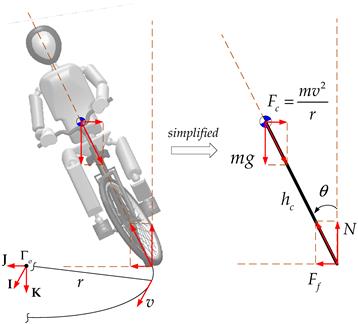
The diagram above demonstrates some of the forces behind bicycle stability. The left side is a simplified model of a moving bicycle. Key forces such as the gravitational force and normal force are highlighted. This diagram shows that a cyclist maintains balance by adjusting their center of mass.
Discussion
The findings of my experiment support my initial hypothesis that a bicycle’s stability is not due to a single factor, but rather due to multiple forces. It is true that the gyroscopic effect and the caster effect contribute to stability. However, neither alone is sufficient. In addition, the built-in self-stability mechanism also plays a major role.
Counter-steering is necessary for being able to maneuver a bicycle. In order to change the bicycle into the opposite direction, a small lean towards the other side is necessary. This is needed for the rider to change direction without losing balance. This process is usually done unconsciously by riders. In addition, the bicycle’s ability to stay upright without a rider highlights the design elements present such as mass distribution and frame geometry, etc. All of these findings align with my hypothesis that bicycle stability involves many factors rather than a single dependent force.
Conclusion
The results of this experiments confirm the hypothesis that a bicycle’s stability is due to multiple factors, such as self-stability mechanisms. These findings help us to better understand bicycle physics. It also shows the importance that rider input has in maintaining a bicycle’s balance. Future research could potentially explore the impact that different frame geometries can have on the bike’s stability.
References
Yoshida, K., & Fujimoto, H. (2017). Design and implementation of model predictive control for a gyroscopic inverted pendulum. Applied Sciences, 7(12), 1272. https://doi.org/10.3390/app7121272
Veritasium. (2021, May 5). Most people don’t know how bikes work [Video]. YouTube. https://www.youtube.com/watch?v=9cNmUNHSBac

This entry is licensed under a Creative Commons Attribution-NonCommercial-ShareAlike 4.0 International license.

