Joel Alex
Course: ENGL 210 (Writing for Engineering) Instructor: Julia Brown
March 28, 2025
Table of Contents
- Definition of a Microwave Oven
- Overview
- Components of a Microwave Oven
- Exterior Structure
- Control Panel
- Magnetron
- Waveguide
- Turntable and Rotating Mechanism
- Power Supply and Cooling System
- Explanation of Functionality
- Visuals
- Conclusion
- References
1. Definition of a Microwave Oven
A microwave oven is an electrically powered appliance designed to heat and cook food by using microwave radiation. Its primary purpose is to reheat, defrost, or cook food rapidly and efficiently. Unlike traditional ovens which rely on thermal conduction and convection, microwaves use high-frequency electromagnetic waves to excite water molecules in food.
2. Overview
The microwave oven is typically a rectangular, enclosed metal box with a front-hinged door. It contains a mesh-like screen to prevent microwave radiation from escaping. The cooking chamber inside the oven has a rotating glass turntable. Inside the microwave oven, there is a rotating glass turntable that ensures even heating by continuously moving food through the microwave. Modern microwave ovens have features such as convection heating to expand their usability beyond just simple reheating. The appliance operates using a magnetron to generate microwave ovens. Modern microwave ovens include features such as convection heating, sensor-based cooking, and inverter technology.
3. Components of a Microwave Oven
- Exterior Structure
The exterior of a microwave oven is made of stainless steel for durability purposes. The door has a transparent window shielded with a metallic mesh to contain radiation. Air vents are placed on the sides to allow proper airflow and cooling.
3.2 Control Panel
The control panel allows users to operate the microwave and adjust cooking settings. It is the user interface of the microwave oven. It includes:
- A digital LED or LCD display for time, temperature, and settings
- A keypad or touchscreen for input
- Pre-set buttons for functions like “Popcorn,” “Defrost,” and “Reheat”
- Power level and timer adjustments
3.3 Magnetron
The magnetron is the main component of the microwave oven. It converts electrical energy into high-frequency microwave radiation, typically at 2.45 GHz. This frequency is chosen because it is effective at heating water molecules and causes minimal interference with most communication devices. The magnetron is powered by a high-voltage circuit.
3.4 Waveguide
The waveguide is a metal tube that channels microwaves from magnetron into the cooking chamber. The purpose of the waveguide is to ensure that microwave waves are distributed evenly. This is done by ensuring that the waves are efficiently transmitted.
3.5 Turntable and Rotating Mechanism
The turntable is a circular glass platform located at the bottom of the cooking chamber. It rotates the food to evenly heat all parts by exposing all parts to the microwave energy. It is powered by a small motor located below the cooking chamber. In higher-end models, a mode stirrer replaces the turntable for more efficient wave distribution.
3.6 Power Supply and Cooling System
The power supply system includes:
- A high-voltage transformer to increase incoming voltage
- A capacitor and diode to convert AC to DC power for the magnetron
- A cooling fan to dissipate excess heat and prevent overheating of internal components
4. Explanation of Functionality
Microwave ovens operate using a series of steps:
Step 1: Microwave Generation
When the microwave is powered on, the magnetron is activated and produces electromagnetic waves at 2.45 GHz.
Step 2: Microwave Distribution
The microwave waves travel through the waveguide, entering the cooking chamber. In the cooking chamber, the waves are reflected off the metal walls to ensure even distribution.
Step 3: Absorption by Food
The microwave waves penetrate the food, exciting water molecules causing them to vibrate rapidly. This molecular motion generates heat through dielectric heating.
Step 4: Even Heating
The turntable rotates, moving the food through different areas of the cooking chamber. This prevents any part of the food from being cold. This helps avoid cold spots and promotes uniform cooking.
5. Visuals
Figure 1: Front View of a Microwave Oven (Labeled Components)
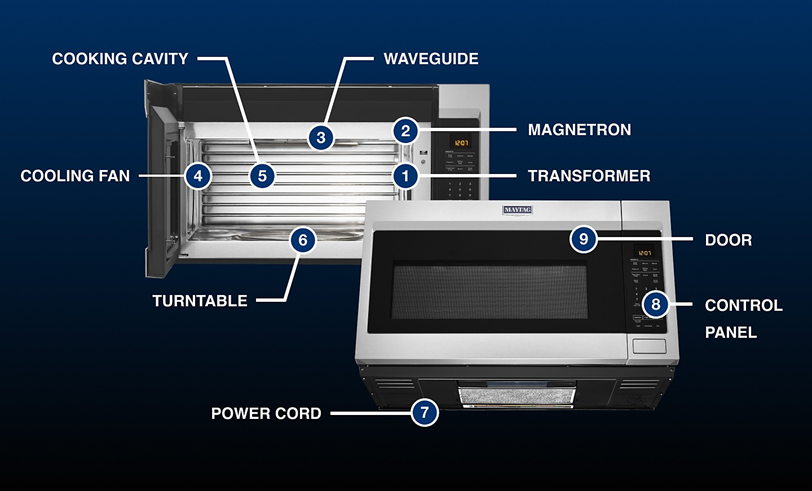
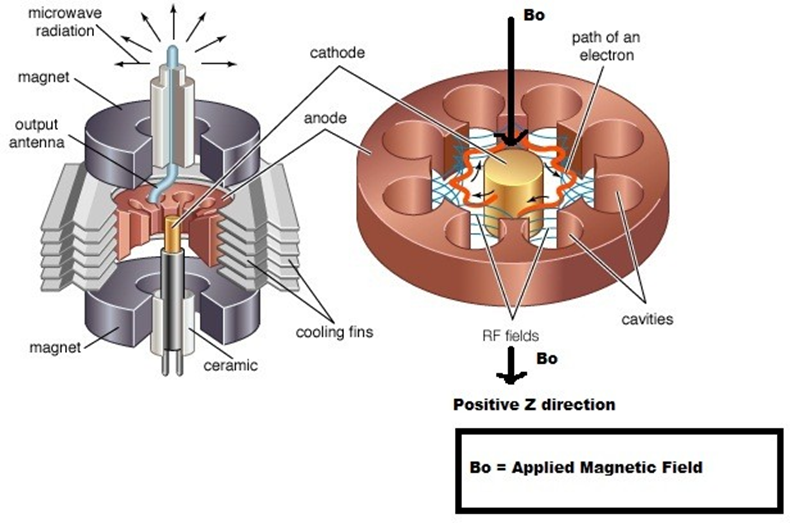
Figure 2: Internal Structure Showing Magnetron and Waveguide
6. Conclusion
The microwave oven is an important appliance that has transformed cooking by allowing for fast, energy-efficient heating. It was first invented in 1945 by Percy Spencer, an engineer at Raytheon, who discovered microwave cooking by accident while working with radar equipment.
Since its introduction, it has undergone significant innovation, including the integration of
sensors and inverter technology. Microwave ovens are available in a range of prices, from $50 to over $500 depending on features such as brand, etc. They are manufactured using materials such as stainless steel, ceramic, and glass. Despite their convenience, proper safety precautions are essential: avoid placing metal objects inside and always use microwave-safe containers to prevent fire hazards and chemical leaching.
7. References
GauravTheLearner. (2013, June). Working of Magnetron. Retrieved from https://gauravthelearner.blogspot.com/2013/06/working-of-magnetron.html
Maytag. (n.d.). Parts of a Microwave. Retrieved from https://www.maytag.com/blog/kitchen/parts-of-a-microwave.html
Whirlpool. (n.d.). History of the microwave: From radar technology to kitchen essential. Whirlpool Corporation. Retrieved March 28, 2025, from https://www.whirlpool.com/blog/kitchen/history-of-microwave.html

This entry is licensed under a Creative Commons Attribution-NonCommercial-ShareAlike 4.0 International license.

